


Dispatch with one FQI system inoperative

The following article provides best practices to prevent on engine fuel starvation when operating under the MMEL with FQI system inoperative.
1. FUEL SYSTEM
The fuel is stored in two main tanks, one in each wing, with a maximum capacity of 2.868 L (ATR 42) and 3,185 L (ATR 72) for each tank.
A 200 liter feeder tank within the main tank ensures fuel is always available despite the effect of negative or lateral accelerations during normal aircraft maneuvers. A feeder jet pump keeps the feeder tank full.
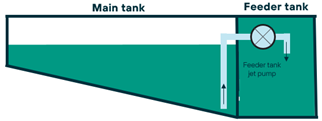
Illustration of the fuel tank
The Fuel Quantity Indication (FQI) system informs the crew of the quantity of fuel available in each tank using 5 (ATR42) or 6 (ATR72) probes per wing tank.
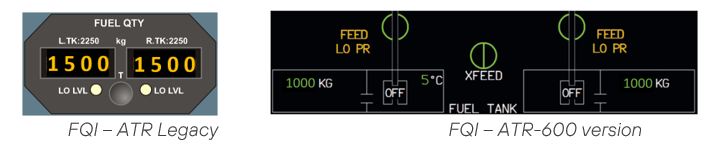
Additionally, the fuel low level alerting system provides a warning to the flight crew when the fuel quantity in the tank reaches a critically low level. It consists of:
-
- A primary alert, when the FQI is below 160 kg.
- Some aircraft are also equipped with a secondary alert, which triggers when the feeder tank is not full.
Note: All -600 aircraft are fitted with a secondary alert. For the other variants check if mod. 4650, 4686, 8148, 8435 or 18078 is installed.
2. MASTER MINIMUM EQUIPMENT LIST
The MMEL allows dispatch with one FQI system inoperative.
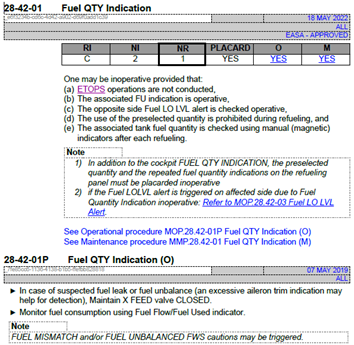
MMEL FQI item for aircraft equipped with the secondary low level
Possible scenarios are inoperative fuel probes, harness or contamination leading to fluctuating, an under or an over estimated fuel quantity, or dashed FQI display mostly due to the loss of the FCU (Fuel Control Unit).
Good practices associated with this dispatch are detailed below.
“
Inform and brief the tanker
”
3. RE-FUELING MANAGEMENT
With one FQI inoperative, the automatic refueling on the Refueling Control Panel (RCP) is unavailable. Manual mode must be used.
The standard manual procedure should be adapted, as the fuel quantity reading for one tank on the RCP is not reliable.
On the Refueling Control Panel, placard:
-
- INOP” on the SELECTED QTY digits.
- “INOP” on the FUEL QTY digits for the inoperative FQI side.
- “MANUAL MODE ONLY” must be used.
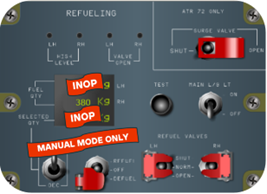
Refueling control with stickers for LH FQI inoperative
Each tank must be refueled manually, one at a time.
Since quantity for one tank is unavailable, use the tanker’s flow meter to control the uplift.
The following method can be followed to guarantee correct refueling.
“
Re-fuel one tank at a time
”
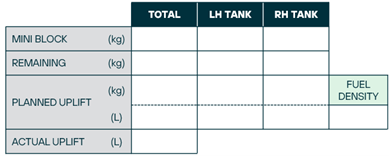
1. Determine the MINI BLOCK quantity (total and per tank) from the flight plan.
2. Obtain the REMAINING fuel on board (total and per tank).
Note: In case of doubt about the remaining quantity on board, verify it via the MMI procedure.
3. Compute the TOTAL PLAN UPLIFT, subtracting the REMAINING to the MINI BLOCK for total and per tank.
4. Obtain FUEL DENSITY from the tanker.
5. Convert the UPLIFT from KG to LITER.
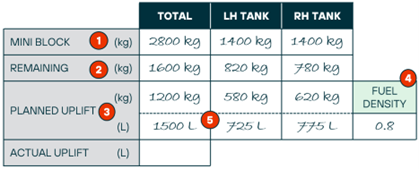
6. Start manual refueling on the side with the inoperative FQI.
7. Stop refueling when the volume delivered is equal to the planned uplift for this tank.
Note: The volume delivered is read on the tanker truck.
8. Start manual refueling of the other tank (operative FQI side).
9. Stop the refueling when the quantity displayed on the RCP is equal to the MINI BLOCK fuel for one tank.
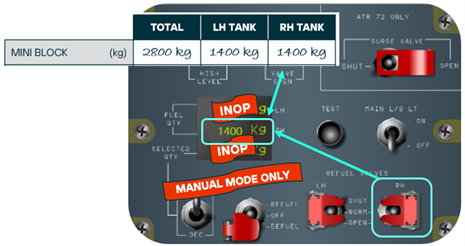
10. Check that the ACTUAL UPLIFT on the tanker receipt matches with the PLANNED UPLIFT
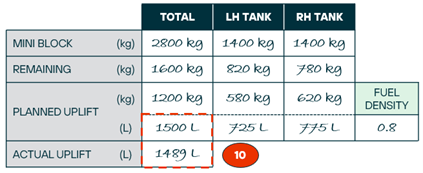
“
MMI after each refueling.
If in doubt on the quantity, double-check.
”
4. DETERMINATION OF THE FUEL LEVEL USING MANUAL MAGNETIC INDICATORS – MMI
The MMEL mandates the verification of the fuel quantity on board using the manual magnetic indicators after each refueling.
For good practices, refer to the video Visual examination of the fuel level.
“
Check fuel consistency.
”
5. CHECK FUEL ON BOARD CONSISTENCY
Once on board, check the fuel quantity on the operative FQI side. The quantity should be half the total fuel determined via MMI.
Any unusually high reading on the operative FQI side should be investigated. The other tank may have less fuel than expected.


