


IN SERVICE FEEDBACK
| Event date : 16 September 2019 | Time : 20:35 UTC |
| Place : Brazil | Aircraft : ATR 72-202 |
1. Serious incident description
On 16 Sept 2019, the airline operated an ATR 72-202 on a scheduled commercial flight from Itaituba airport (SBIH) to Eduardo Gomes airport (SBEG).
|
1st segment From SBBE TO SBHT |
2nd segment From SBHT TO SBIH |
3rd segment From SBIH TO SBEG |
|
| Refueling | 906 kg (voucher) | 1 015 kg (voucher) | NO |
| Fuel on board | 2 600 kg (logbook) | 2 800 kg (logbook) | 2 022 kg (logbook) |
| Fuel burnt | 790 kg | 778 kg |
Before performing the third segment the fuel available recorded in the logbook was 2 022 kg.
These 2,022 kg of fuel available in the tanks were less than the 2,116 kg established in the planning of the flight to SBEG airport. The crew didn’t refuel at SBIH airport.
During the flight, the crew received information that the SBEG airport ceased operations due to an accident involving another aircraft.
While approaching SBEG, the crew coordinated with ATC delaying procedures for delaying their arrival in SBEG. However, with no forecast for the reopening of the aerodrome, the crew decided to divert to the alternate airfield.
The information contained in the flight plan indicated that the aircraft would need 705 kg of fuel to reach the alternate Aerodrome of Tefé (SBTF), in addition to 477 kg to fly an extra time of 45 minutes (totaling 1,182 kg).
The FQI indicated that the aircraft had approximately 1,200 kg of fuel, which was enough to proceed to the diversion aerodrome. However, the PM suggested changing the alternate airport listed in the flight plan (SBTF) to the aerodrome of departure (SBIH), since the latter was nearer, with weather conditions known to the crew. SBEG was 253 NM away from SBIH and 281 NM from SBTF.
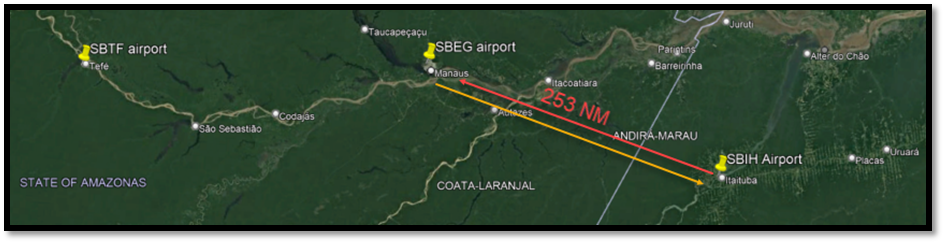
According to statements, after the crew’s decision to return to Itaituba airport (SBIH), they were maintaining FL 190 (cruise level), when the FUEL light on the CAP came on for some time and then went out but the LO LVL amber light remained off.
To expedite the approach, the crew performed a descent to join the traffic pattern of SBIH (VMC conditions). When the aircraft was close to the base leg and configured for landing, the left engine shut down and, after landing, during the taxi, the right engine also stopped working. The crew restarted the right engine, and the aircraft continued taxiing to the parking area.
2. Tests and research from the report
The information obtained shortly after the occurrence recorded that the quantity of fuel indicated in the FQI corresponding to the left wing tank was 230 kg, and 180 kg in the right wing tank. The Fuel-Level Magnetic Indicators showed zero fuel.
On 18 September 2019 (2 days after the event), the aircraft received 2 537 liters of fuel which represented a weight of 1 935 kg.
- The FQI indicated 2 390 kg (1 190 kg Left Tank / 1 200 kg Right Tank).
- The fuel level magnetic indicators showed 2 233 kg (1 040 kg Left Tank / 1 193 kg Right Tank).
On 20 September 2019 (4 days after the event), a functional test was performed on the six fuel probes of the wing tanks.
- The number-3 fuel probes of both wings were out of the parameters and were replaced. The same occurred with the Harness (Cabling), of the number-3 fuel probe of the right wing, which was also out of the parameters and was replaced.
- The indication of low fuel-level in the FQI of the left wing tank was still not appearing, leading to the replacement of the number-1 fuel probe.
On August 2021, the components removed were sent to SAFRAN Aerotechnics (France) for specific bench-tests and identification of any possible compromises.
- Fuel Probe S/N 1647: Pollution was observed inside the tube, oxidation in the electrical box, and scratches and shocks on the probe head.
- Fuel Probe S/N 1358: Scratches was observed, traces of impact, and oxidation of the probe head, along with scratches on the outside of the tube. No oxidation was visible in the electrical box. There were also signs of pollution inside the tube.
- Fuel Probe S/N 516: it was observed scratches, traces of impact, and oxidation on the probe head. Pollution was visible inside the tube, as well as oxidation in the electrical box.
Despite the damage observed, the tests did not indicate any abnormalities.
- Harness: the connectors were in good condition, and there was no visible damage to the respective pins. However, there was a splice observed close to the identification label. One clearly verified that several wires for protection of the cabling were broken. The cabling underwent two electrical tests for resistance, insulation and continuity. The item passed both tests.
3. Contributing Factors from the report
4. ATR recommendations
- Refer to previously published material available on the ATR Flight Safety website:
Download the PDF Article: The ATR fleet has encountered events associated with erroneous fuel quantity indication.
Download the PDF from the safety conference took place in Rome – Nov 2023:
- In-service feedback confirmed occurrences of a Master Caution flashing amber, FUEL amber message on CAP but with no associated local alert – LO LVL amber light on the Fuel Quantity Indicator (FQI). This has occurred on aircraft equipped with the Multi-Function Computer (MFC) standard 4 (or above) without having retrofitted the previously optional Service Bulletin for the secondary fuel low level function.
- Accordingly, ATR highly recommends that operators with ATR 42 & 72 aircraft equipped with only primary fuel low level function and MFC standard 4 (or above) to implement the ATR service bulletin for the fuel secondary low-level function to prevent re-occurrence of the in-service feedback.
Note:
-
- Primary FUEL Low Level:

-
- Secondary Fuel Low Level:

5. Report
The final report in English is available for download at Final investigation report

