


During disembarkation, one passenger at the top of the steps, held the right-hand handrail. As she began to move down the steps, the handrail collapsed unexpectedly. The passenger lost balance, landed on the apron right and sustained a head injury.
The chapters 1 to 4 are factual elements from the published report. Chapter 5 is the ATR additional comments.
Passenger door handrail collapsed
| Event date : 12 November 2024 | Time : 14:00 UTC |
| Place : Helsinki-Vantaa Airport | Aircraft : ATR 72-212A |
1. ACCIDENT DESCRIPTION
On 12 November 2024, an ATR 72-500 on a scheduled commercial flight landed at Helsinki-Vantaa airport. The flight was carrying 9 passengers and 4 crew members.
A member of ground staff knocked on the passenger door to indicate that the cabin crew was cleared to open the door and passengers could disembark and proceed to board a bus waiting next to the airplane. The senior cabin crew member (SCCM), who was stationed at the rear of the cabin, opened the door, and two handrails of a set of steps that is integral with the door deployed. Once the bus driver had signalled that passengers were cleared to board the vehicle, disembarkation began.
After most of the passengers had exited the airplane, two remaining passengers arrived at the door, one of them carrying a lightweight suitcase and a canvas bag in her left hand and holding a small handbag in the crook of the right arm. At the top of the steps, the passenger held the right-hand handrail. As she began to move down the steps, the handrail collapsed unexpectedly. The passenger lost balance, landed on the apron and sustained a head injury.
2. PASSENGER DOOR HANDRAILS
Before opening the door for normal disembarkation, the cabin crew member (CCM) must move the pin into a locating hole in the “ground/disarmed” stanchion to lock the handrail upright. Before beginning disembarkation, the CCM must verify that the pin is correctly positioned, and the handrail is firmly upright. The CCM needs to move the pin between the stanchion and a stowage bracket both before opening and immediately after closing the door.
In flight, the pin is in the “flight/armed” stowage bracket. In the event of an emergency, it would be left in the bracket, and the handrail would remain stowed when the door is opened to allow expeditious and unhindered disembarkation.
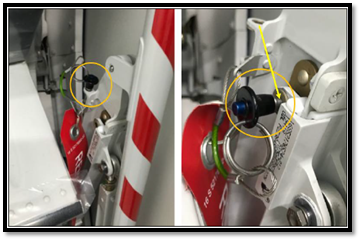
Quick-release pin locations.
On the left, the pin is in in-flight (“flight/armed”) location.
On the right, it has been moved (yellow arrow) to the “ground/disarmed” location.
The above-described normal procedure is standard except where the handrail is stowed to allow disembarkation via a mobile ramp.
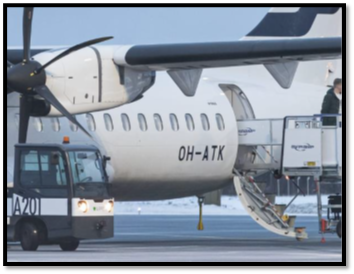
Mobile ramp
3. CONTRIBUTING FACTORS FROM THE REPORT
The purser opened the door in an environment that may have affected concentration. Cross-checks by another crew member or other safeguards were not in place to guard against the effects of a human lapse.
The location of the quick-release pin, or any other solution based on visual observation, does not draw adequate attention to the locked or unlocked condition of the collapsible handrail. An unlocked handrail (Quick release pin in “flight” location) may inadvertently remain upright during door opening.
4. SAFETY RECOMMENDATIONS
- ATR establishes requirements for the maintenance and verification of the correct function of the collapsible handrail.
- ATR improves the observability or location of the quick-release pin with the aim of drawing full attention to the condition of the collapsible handrail.
- The operator endorses a revised procedure requiring that the passenger door shall be opened using support from the other cabin crew member, and/or prepares a door opening checklist.
- The operator pays increased attention on the implementation and follow-up of corrective actions in Safety and Risk Management.
- The Ministry of Transport and Communications updates its Joint Action Plan in the Event of Civil Aviation Accidents, adds to the plan a description of provision of support to accident victims and their families and informs stakeholders accordingly.
- The operator harmonizes flight crew and cabin crew procedures regarding alerting instructions when the airplane is parked.
5. ATR RECOMMENDATIONS
- AOM 42/72/2016/11 issue 3 published in August 2025. To avoid the risk of a passenger injury, this AOM recommends:
a) The operator to replace at the first opportunity, the current quick release pin P/N MS17990C412 by a new interchangeable pin P/N MS17984C412.
b) Operator cabin crew members to follow the CCOM procedure, to check that the quick release pin is in good condition, and to make sure that, while opening the door prior to each boarding or disembarkation, the quick release pin is correctly locked.
c) The line maintenance staff to check that the quick release pin and red warning streamer are correctly installed.
To confirm the correct function of the forward secondary handrail release mechanism, ATR recommends all operators to perform, at the next suitable opportunity, the Operational test of the system in accordance with the instructions of the MP ref. ATR-A-52-11-20-01ZZZ-320Z-A. If the handrail remains in the incorrect position after the accomplishment of the MP, contact the local ATR Customer Support Center via “Request ATR” on the ATRactive portal to obtain additional instructions.
The AOM is available for download at AOM 42-72-2016-11 issue 3 – Passenger Crew door forward handrail operational test.
- ATR stresses the location of the quick release pin needs to be positively confirmed by the cabin crew.
6. FINAL REPORT
The final report in English is available for download at Final investigation report.

